
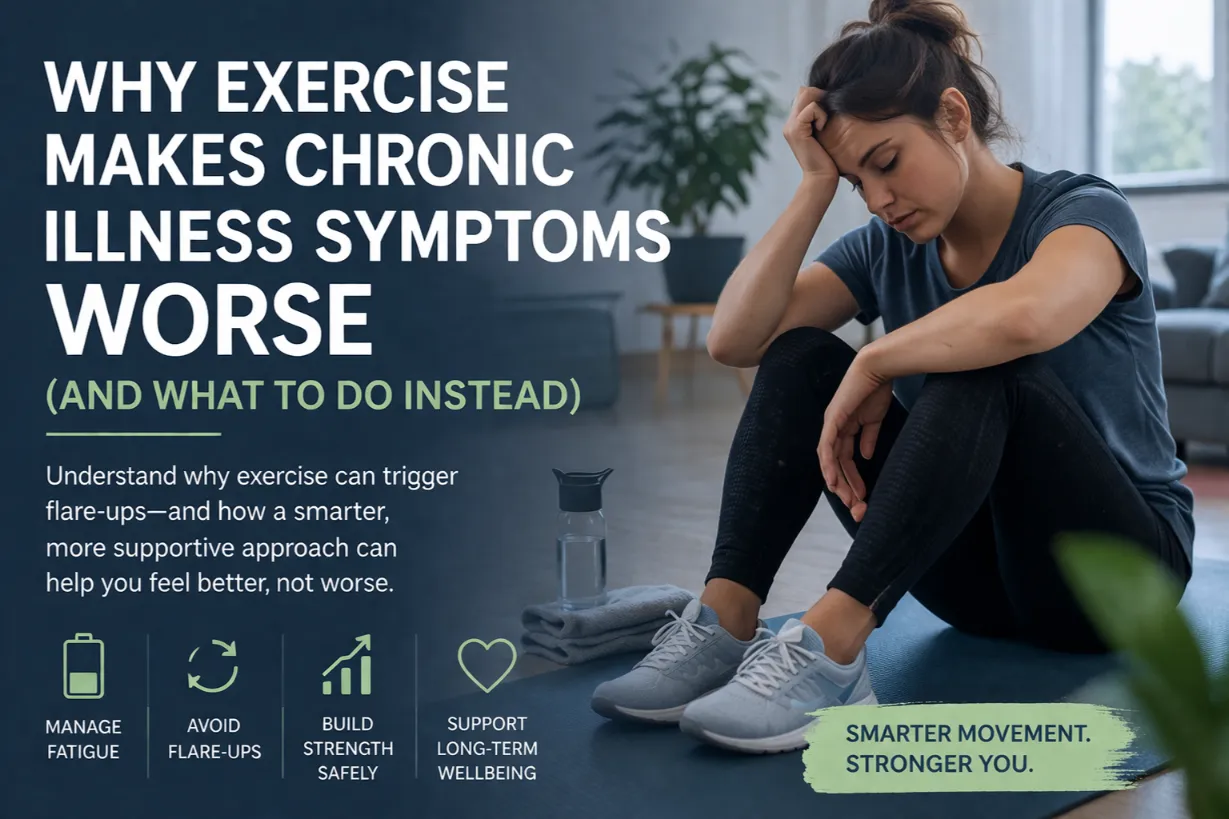

If you’ve ever tried to exercise with a chronic illness and felt worse afterwards, you’re not alone.
Many people are told that exercise will help—but when it leads to fatigue, pain, or flare-ups, it can feel confusing and discouraging.
The reality is that exercise can help—but only when it’s approached in the right way.
Many people are told that exercise will help—but when it leads to fatigue, pain, or flare-ups, it can feel confusing and discouraging.
The reality is that exercise can help—but only when it’s approached in the right way.
Why Exercise Can Make Symptoms Worse
For people with chronic illness or disabilities, standard exercise advice often misses key factors.
1. Doing Too Much, Too Soon
Many programmes start at a level that’s simply too high.
This can:
– overwhelm your energy levels
– trigger post-exercise fatigue
– lead to setbacks
Many programmes start at a level that’s simply too high.
This can:
– overwhelm your energy levels
– trigger post-exercise fatigue
– lead to setbacks
2. Ignoring Energy Limits
Conditions like ME/CFS, fibromyalgia, and long COVID involve limited and fluctuating energy.
Pushing beyond your capacity can result in:
– crashes
– prolonged fatigue
– reduced function for days or weeks
Conditions like ME/CFS, fibromyalgia, and long COVID involve limited and fluctuating energy.
Pushing beyond your capacity can result in:
– crashes
– prolonged fatigue
– reduced function for days or weeks
3. Generic Fitness Plans
Most workout plans are designed for healthy individuals.
They don’t account for:
– pain sensitivity
– neurological symptoms
– mobility limitations
Most workout plans are designed for healthy individuals.
They don’t account for:
– pain sensitivity
– neurological symptoms
– mobility limitations
4. Lack of Recovery Time
Recovery is often underestimated.
For chronic conditions, recovery may take longer—and needs to be built into your plan.
Recovery is often underestimated.
For chronic conditions, recovery may take longer—and needs to be built into your plan.
Signs You Might Be Overdoing It
You may be doing too much if you notice:
– fatigue that lasts more than 24–48 hours
– worsening symptoms after exercise
– needing long periods to recover
– reduced ability to stay consistent
These are signs that your current approach isn’t sustainable.
– fatigue that lasts more than 24–48 hours
– worsening symptoms after exercise
– needing long periods to recover
– reduced ability to stay consistent
These are signs that your current approach isn’t sustainable.
A Better Approach to Exercise
Instead of pushing through, a more effective approach focuses on:
Pacing
Balancing activity with rest to avoid flare-ups.
Balancing activity with rest to avoid flare-ups.
Starting Below Your Capacity
This might feel “too easy”—but it allows your body to adapt safely.
This might feel “too easy”—but it allows your body to adapt safely.
Gradual Progression
Progress is built slowly over time, not rushed.
Progress is built slowly over time, not rushed.
Flexibility
Your plan should adapt based on how you feel day to day.
Your plan should adapt based on how you feel day to day.
What Exercise Should Feel Like
With the right approach, exercise should feel:
– manageable
– controlled
– sustainable
Not exhausting or overwhelming.
You should be able to finish a session and still feel capable of continuing your day.
– manageable
– controlled
– sustainable
Not exhausting or overwhelming.
You should be able to finish a session and still feel capable of continuing your day.
When to Get Support
If you’ve struggled with:
– repeated flare-ups
– inconsistent progress
– uncertainty about what’s safe
then working with someone who understands chronic conditions can help you find a more effective approach.
– repeated flare-ups
– inconsistent progress
– uncertainty about what’s safe
then working with someone who understands chronic conditions can help you find a more effective approach.
Is it normal to feel worse after exercise?
It can happen—but it’s usually a sign that the intensity or volume is too high.
Should I stop exercising completely?
Not necessarily. Reducing intensity and adjusting your approach is often more effective.
How do I know what level is safe?
Start very low and build gradually, paying attention to how your body responds over time.
A More Sustainable Way Forward
Exercise shouldn’t leave you feeling worse.
With the right approach, it can become something that supports your health rather than disrupts it.
With the right approach, it can become something that supports your health rather than disrupts it.
